Case Studies
Junya Ishigami
Plaza with sloping floor for the Kanagawa Institute of Technology in Japan.


In this image the students are sitting under the sunlit cut of the space. It in a way creates sectioned spaces within the space. when it is sunny people are drawn to that area. However, when it could be raining they would avoid it. This kind of design gives a push and pull effect.

because the building is built in a type of basement level, the slope of the ground it is build next to it almost reaches the roofing. Makes me wonder if that makes people have the urge to climb over top as it appears low enough.
The way they are cut changes the scene depending on the weather. If staying in the space for a long period of time, you can watch as the clouds and the sun move.
Three-pronged visitor centre for Dutch park with Marieke Kums of Rotterdam practice Studio Maks


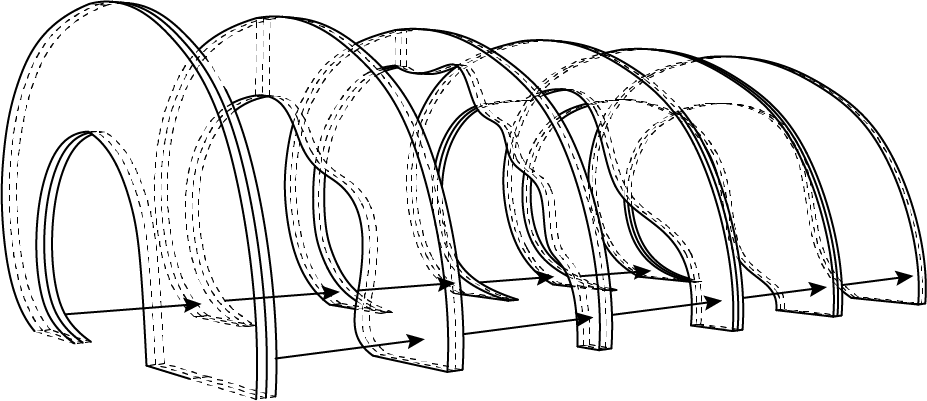
I love spaciousness of this pathway, and how it crates a divide into the sections of the space, though being about to experience all the sections of the space within it as well. Thought walking through it the bass is sectioned and which direction you face it is like a frame, so as you walk through, with each frame the view slightly transitions. By the end of the route, you would have ended with a whole new direction and picture.
Cloud Garden nursery with cloud-shaped walls inside a high-rise block


Oribe Tea House by Kengo Kuma
https://www.thisispaper.com/mag/oribe-tea-house-kengo-kuma


just an image I saw on Pinterest, though I couldn’t find the source. However, this is the kind of think light I wish to translate in my entrance.
How have I connected different scenes?
I have used the transitions of crossfade and fade in play out through my site documentation.
I will incorporate these transitions into my spatial models by allowing various components ie. sunlight, sound etc. into the space to alter it throughout time and/ direction.
Circulation
http://portico.space/journal//architectural-concepts-circulation
Different types of circulation require different considerations
- direction of movement: horizontal or vertical;
- type of use: public or private, front of house or back of house;
- frequency of use: common or emergency; and
- time of use: morning, day, evening, continuous.


The circulation types I hope to play upon are horizontal, vertical and public. The only one I wish to cut out is private as we want to bring back the social life that is conveyed Roxy and Everybody’s flowing into the Imperial lane as well. I will play upon transitions of light, and reflection – light and sound in my spatial model prototypes.
Sound inducing Material Research

Light and sound waves works in the same way. When thinking about light, off your head, you’d think of a surface that’s more polished but in fact every single object reflects light. That’s how we perceive it at least. the human eye is not able to catch such small reflectance that we only would think what we can see is the truth. This is the same with sound waves, people don’t tend to situate themselves within a space because of sound. Bit just because we can’t hear every little bit of the sound reflection doesn’t mean it isn’t there.
Certain properties make sound reflection more successful:
Hard: which is why acoustic foam is a sound absorber, rather than a reflector
Dense: because porous materials can trap air and, therefore, sound as well
Flat: even though irregular surfaces, flat ones are better at bouncing the sound evenly in all directions
if a material lacks one of these properties, it loses some of its reflective ability.
Examples of Materials that reflect sound:
marble
granite
clay brick
ceramic tile
smooth concrete
plaster
metal
glass
plastic
wood
calm water
heavy flat curtains
How cuts show time and space.

I will probably create the opposite of this scene where it would be emerging, as I would like to create a scene that unfolds what is there what cannot be seen in the beginning.

https://www.experienceadelaide.com.au/public-art/art-in-adelaide/cascade/


I randomly came across this sculpture by Sergio Redegalli when I was trying to find if there were any large-scale glass/acrylic designs for me to find out if it was possible to create a entrance installation out of glass- would it be stable or sturdy enough? I was surprised to find Redegalli’s Float Glass and Silicone sculpture as it really resembled the wave formation as I had created in my surface design. Allowing me the confirmation that it is possible to work with glass in this if I wanted.


One of the things I love about the the surface model I had put together was how the solvent created mini waves within the larger piece so I wanted to trace it to see if there is anyway I could further develop to incorporate it in the facade. To me after sketching it, it looks like a map with mountains and roadways crossing through. I started asking myself ok so I have this outline drawing, now what? Yes the shapes has kind merged into one, but I can also see the layering of the shapes. Could I possibly create another piece of layering on the facade of the building. Possibly using some sort of metal or I even continue this line pattern and creating lights layering over each other kinda like the existing eyesight lane that is extended through the lane building.


I tried playing with how I could possibly layer over the building to create a facade. I duplicated it and rotated it to fit it on the building and it kinda continues the wave like figure but towards the entrance from both sides to draw visitors to the entrance. I tried out drawing solid shapes to possibly layer it over each other and see how it appears.


Decided to resize and adjust to the one of the Imperial buildings as that is the space I wanted to transform. Also changed the colour of the sketch since that is not colours I plan to uses it also looks like fire. It’s going to be also thick glass layered over each other.
I did this as I was confused if I needed to change the façade of the building when I just did the entrance. However, after talking to Sue I realised the façade is just the front of the building and it is already altered a bit by my entrance so I might night go with this anymore. However I could incorporate in into the interior of the building later.
Conceptual Key terms and how I will integrate it in my design.
- AID
an aid is to give help or assistance.
I plan to convey this aspect throughout my chosen space. Starting at the entrance, - LAYERS
a sheet, quantity, or thickness of material, typically one of several, covering a surface or body.
With each layer the visitor should be able to unravel/uncover the true picture. - WAVE
1. a long body of water curling into an arched form and breaking on the shore.
2. a sudden occurrence of or increase in a phenomenon, feeling, or emotion.
I plan to incorporate this aspect into my design as I wish people to experience the high change of emotions – intrigued, confused, scared? excitement. The whole point is it would change through each moment into new sections of the space.








 Belinda's Blog