Author: Belinda Tran
Starting to finalise idea
17/10
Talked to Michell today and the key topics talked about are
- materiality
- how the entrance connects to the building – is it freestanding? how do I make it connect and flow with the space instead of looking like its just placed there.
- possibly making a similar structure to the entrance that wraps around the whole of the interior of the first floor – turn it into seating/tables
- extending the entrance outwards to attract with the public outside – make them intrigued what is there
- light strips in between panels?
- colour of panels – the curves that still remain in the rhino file looks really interesting – reminds him of string wrapped around
- project name – working name was wave? as I was initially was playing with the different meanings of what a wave is. However, not sure if the project has continued in that direction.


The entrance is free standing as the thick glass material is strong enough. Though there is concern over what if it were to topple over each other like dominoes. So possibly insert columns inbetween each panel to keep the hold sturdy.

Currently realising the current arrangement of the second floor doesn’t align with the building. As it doesn’t make sense that I arranged the restrooms to be right in-front of the front windows. I think I need to move the restrooms to the the other side of the building. Though it would mean I also need to rearrange other parts of the building as well.

Realised there is restrooms across from the other stairs for the other side of the lane as well now but I already implemented restrooms in my design. So maybe I cut out those stairs from my design. As it is not part. The round stairs is the main source to get between the first and second floor.
I was talking to Lilliana and she was telling me how I could turn my curves into light strips and I am thinking if I should use this in my entrance panel edges. I could have it illuminate at different brightnesses as we walk into through it.

I thought about how could I extend the entrance outward to Fort Lane so it would draw guests into the laneway and felt this this way would be the best way to bring it in as it still contains features of the entrance tunnel I have designed already.

Now how will I close up the space?
roll-up doors? to install on both sides of the passageway that sits on Fort Lane.
Kinda don’t like the look of the room up doors.
Or just normal doors? I could use a wooden door and would make
Was thinking to transform the passageway further to possibly implement seating like Michell mentioned to me. However, another presence could be distracting and try to hurry people out. As some people aren’t as comfortable being in a tighter space with a stranger.
Talking to Tiffany and she mentioned about how because of how thick the glass is it won’t be as transparent as I hope to be. Though if I make the front transparent as well, it might not show through as the glass would be quite thick and also because the passageway at the entrance is also transparent it will be strange.

Re-adjusted the entrance to be more levelled. Also, realised in the entrance passageway the focal point near the head of it is the stairwell as it is right ahead.


Realised the it may be too think so tried to extrude it to make it more thicker but now I think it might be too thick?
I don’t really like the look of it as much ? Also, would it change the outcome of the shadows? it is the other key point of the design other than the wave itself in this section of the space. It make make it too chunky where the shows wouldn’t be that nice.

I struggled with making the it thinker and it appears ti not line up and/or overlap over the exisiting surface so doesn’t work very well. I also find it rather chunky so let’s discard that.
It however, does make the shadows more bolder against the wall.
LIGHTING
LED lighting can be used to provided general illumination but also allows flexibility for theatre designers to give certain areas a more unique feel. Fixtures, strip lights, and LED bulbs can play a role here.
Opt for wall sconces or can recessed lighting.
with wall sconces, you get a good mix of uplight and downlight to create a gentle lighting level for hallways or seating areas. Recessed cans offer a more directed light source than wall sconces, but is a gentler option than traditional tube lighting.
Co-Design Workshop Feedback/Reflection
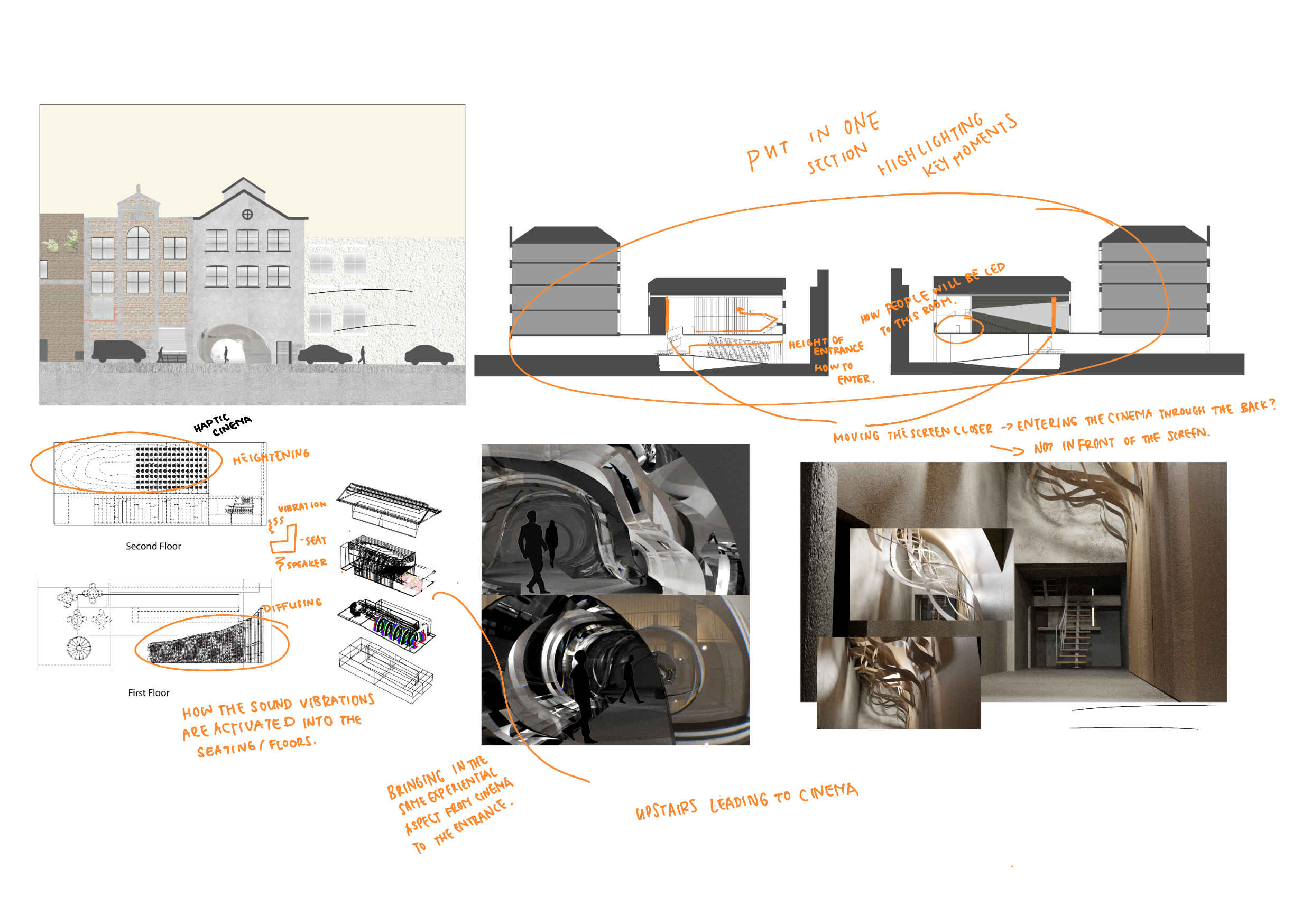

Considering an image of the cinema would be best to use as the hero image as it is the key experience in the space. Though I need to consider how I will bring in all the experiences of all the points in the design into this particular space. As the hero image needs to ell the story of the whole space.
- lighting
- shadows
- sound haptics (visually shown)
- colour
- people (movements)
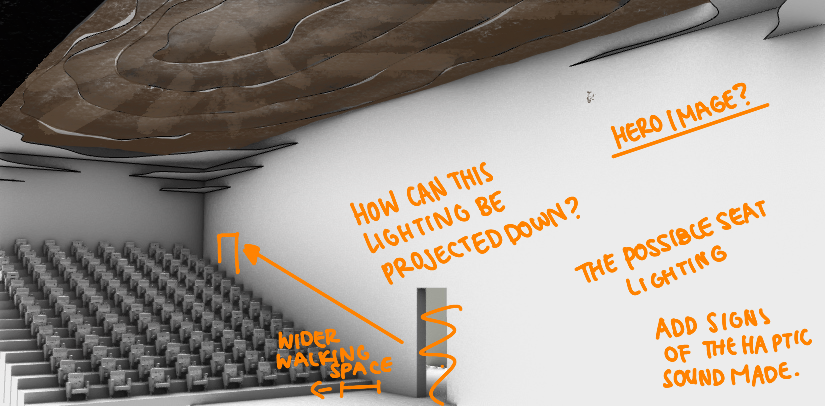


hearing people are used to sensing vibrations from their fingertips to the soles of their feet. So the haptic experience should be integrated into the flooring and also into the seat.

Current Plan for Imperial Lane
I have decided to create a cinema to highlight the transition between two worlds in this case more towards the hearing and non-hearing worlds. The cinema is to showcase the non-hearing world where I plan to create an experience of watching the movie through visuals and haptic sound. Though audio sound could still be used but it is not a crucial part of my design.

Ground Floor

Second Floor

Exit ( on ground floor towards Queen Street )

actual scaled plans to be uploaded later today.
Exploded View

Mapping the site


Talked to Sue and she told me how I’ve been overthinking everything that’s why I haven’t settled on my design concept yet. After talking with her I think I will stick to designing a cinema space. exploring visual noise and possibly integrating haptics into it. Also, in my written feedback by Vena he mentioned how I should explore more on a multi-sensory experience using colours, shadows, and vibrations to help people with hearing limitations better understand or be alert to their surroundings.
“significant limitations to CIs remain, with users often having considerable difficulties locating and segregating sounds [2,3]. Similar issues are experienced by hearing aid users, though to a lesser extent [3,4].”
Mark D. Fletcher (2021) Using haptic stimulation to enhance auditory perception in hearing-impaired listeners,Expert Review of Medical Devices, 18:1, 63-74, DOI: 10.1080/17434440.2021.1863782
“One of the comments received from a profoundly deaf user when the Haptic Chair was no longer available (“I am going to be deaf again”), poignantly expressed the level of impact it had made.”
This article addresses whether the combination of visibility and touch enhances the hearing experience of those hard of hearing.
this clearly expresses the impact it had made towards those hard of hearing. They find other ways to make up for the the set they are lacking to be able to understand a full picture that everyone else experiences.
Suranga Chandima Nanayakkara, Lonce Wyse, S. H. Ong & Elizabeth A. Taylor (2013) Enhancing Musical Experience for the Hearing-Impaired Using Visual and Haptic Displays, Human–Computer Interaction, 28:2, 115-160, DOI: 10.1080/07370024.2012.697006

Incorporating speakers under the floor to create vibrations at the feet to really indulge into the scene ahead. Feeling the show/performance reasonates with the human mind more than just being able to see it on its own.


Exisiting device for hard of hearing people to experience listening to music but through vibrations.
https://www.healthyhearing.com/report/53155-Buzz-device-routes-sound-through-skin

https://patents.google.com/patent/US8638966B2/en
https://masschallenge.org/article/haptic-technology
Plan for designing a deaf experience

We are wanting to create a space where it is inclusive and everyone experiences it just the same.
How can I create transitional spaces to showcase the experience as a hearing impaired person to normal-hearing people at the same time accommodate those who are hearing impaired to experience the space the same as the other people are?
If I were to make rooms evoking sound how can I make it more inclusive to the non-hearing?
non-hearing relies on:
-sign language
-subtitles
-lip reading
Can I manage to showcase sound in another media? – visual/touch
My plan on how I will proceed from here.


Realizing my Hearing – Recent Personal Discoveries
| I was taking a shower and came to realize that I couldn’t hear the water running as I had thought I was hearing. I had grown so accustomed to the sound of running water whilst wearing my implants that even without it, my brain already associates the sound to the sight of it. In turn tricking my brain into thinking I could hear the water running. |
| People wake up to sound, but I wake up to vibrations and spatial presence. Being profoundly deaf I hear close to nothing without my aids. When it comes to setting alarms, I must set my phone next to me on the bed to feel the vibrations in order to wake up as I am unable to hear it. I also am sensitive to movements around me or leading to my space, as I would be suddenly awakened if I feel the presence. I have wondered why this was. Now I figured it’s probably because having the loss of hearing has sharpened my spatial awareness to act as a survival mechanism. |
| Early morning, I get out of bed and start my day. First thing is to freshen up but during this step I prefer to do this with a hushed and serene mind and space. So, putting on my aids is not something I gravitate to doing just yet. However, as I am in a house with other occupants, they are trying to ignite conversation with me. I do not have the capacity to engage in the conversation just yet though as I am unable to apprehend what is being spoken. Though I do catch pieces from lip-reading and, I am somehow able to feel the vibrations along with the hums I can formulate. |
#1 associated memory of objects creates the sound.
#2 hearing the environment through other means but the ears.
#3 sometimes vibrations aren’t only felt directly on your skin, but it travels through the air towards the intended direction.
– vibrations are always present no matter how small the source of the sound is.

The Gallaudet University campus in Washington DC, designed by Hansel Bauman (2005), provides a precedent of thoughtful application of DeafSpace principles in an architectural and urban design context and can be explored in more detail through Gallaudet University literature[5]. Their design clearly acknowledged differences in d/DHH communication and movement styles, featuring:
- ‘conversation circles’,
- indirect lighting to minimize shadows,
- walkways with clear visual signalling, and
- strategic placement of mirrors and lights.
BEFORE COCHLEAR IMPLANT(CI) SURGERY
“You just kind of feel like an outcast. You kind of feel like you are a pain if you draw attention to it. So yeah that could be pretty… pretty lonely to do that and miss everything around you, and just… it used to make me feel more disabled, but I used to feel like if I just sat there quiet and invisible that it would just be easier. You know?”
“You feel like, you are too hard to be friend with it’s too much work. And I think I was probably a difficult person in that regard to… to socialize with and I think a lot of people can’t relate to that. I think to a large degree, I was in my own little world and just doing my thing and I guess to a degree you don’t know what you are missing, but that’s just the way it is”
AFTER COCHLEAR IMPLANT(CI) SURGERY
“It was gaarbled. She sounded like Donald Duck and… and oh my God, everybody is going to sound like that, what have I done? And there you get that momentary panic, going oh my God. But it was like an awakening.”
“I… I feel much more included in everything. I feel closer to everybody. It’s just a good feeling to be able to… to feel like you’re part of everything, instead of just feeling excluded in everything all the time. Oh, it’s a real bonus.”
Lori Kuffner (Producer), & Kuffner, L. (Director). (2004). Learning to Hear. [Video/DVD] Filmakers Library. Retrieved from https://video.alexanderstreet.com/watch/learning-to-hear
“…it isn’t sound the way he remembers it; rather, the implants are tricking his brain into thinking he’s hearing.”
Sounds hearing after implants are not the same as hearing with your ears. The static-ey/robotic noises heard through every noise passing through the machine to your brain needs time to get adjusted to and tricking the brain into thinking the sounds is normal. Eventually the sound effect will wear off. Which will make the sound you now hear appear normalise it should.
With implants we are not hearing through the ears anymore. But hearing through the brain.
Murphy, M. (2020, December 8). What Hearing Loss Feels like in ‘Sound of Metal’. The New York Times, p. 6. Retrieved from https://www.nytimes.com/2020/12/04/movies/sound-of-metal-hearing-loss.html
Own Experience walking in the city without my aids:
- Faint vehicle engine
- Anxiety
- What if I die?
- Is that guy trying to talk to me? looks like it but can’t tell
- Peoples Voices if walking right past them but incoherent
- Highly alert
- Cautious of surroundings
- Hearing sounds but don’t know the source
- Think I hear skateboard coming at me but there isn’t. Where is the sound from?
- Crossing roads reliant on visual aids
- Crossing roads without traffic lights or zebra crossing is scary
Overall, besides feeling anxious and overly alert. I also felt like I was in one of those scenes in a movie where I can see the world just moving fast in front of me as it is inaudible and like I am watching in from another dimension.
Follow-up question:
Do people with hearing impairment who do not rely on aids feel like this all the time? Or are they used to it so don’t feel that way anymore? And am I too dependent on my aids now that when it is taken away I struggle to adapt?
After my little experiment a friend who is a pharmasist reached out to me about her experience encountering hearing impaired patients at work. R

I find it interesting these patients put themselves out there in a position to likely to trigger anxiety and stress over not being able to hear.
undefined [De Montfort University]. (2017, October 3). Being Heard: Experiences of people with mild hearing loss[Video]. YouTube. Retrieved from https://www.youtube.com/watch?v=_brh-Iha0sg
Interview with people with mild hearing loss. I came to realise I also experience the same as these people did without hearing aids even when I am using my cochlear implant. Goes to show the hearing cannot be fully restored. Even with extra help.
transforming sound into other forms to view
-seeing the sound – as vibrations – can feel too
Harcourt, H. M. (2016, December 13). How to See Sound Vibrations. YouTube. Retrieved from https://www.youtube.com/watch?v=BET80REhFco&feature=youtu.be
Which focus am I wishing to portray in my design?
- aliening aspect
- anxiety
- switching between hearing and non-hearing world
- translating sound to feeling/visual
- viewing the world from another space in silence – detached from the real world
- visual – hidden


Formative Takeaway

The key focus
What’s next?
Target audience
Auditory Hallucinations – uncovering sound
Just yesterday as I was in the laneway I had another me just hearing sounds that makes me question if I am actually hearing something or if I’m imagining something that does not exist again? It have this happen rather frequently in my everyday life hearing sounds that does not exist, so I decided to find out if it has any connection to my hearing impairment. After finding out it is actually rather normal, I plan to incorporate this in my project since I’m already using sound and create the movement of uncovering – I decided it would make sense for me to add in the part where the visitor to experience as such as I do like one of my keywords – wave, one of the definitions is a sudden occurrence of or increase in a phenomenon, feeling, or emotion. I wish for the visitor to have the sudden changes of feelings from intrigued, surprised, confusion, fear?, comfort all felt in one space.
Theresa M. Marschall, Branislava Ćurčić-Blake, Sanne G. Brederoo, Remco J. Renken, Mascha M.J. Linszen, Sanne Koops, Iris E.C. Sommer,
Spontaneous brain activity underlying auditory hallucinations in the hearing-impaired, Cortex, Volume 136, 2021, Pages 1-13, ISSN 0010-9452, https://doi.org/10.1016/j.cortex.2020.12.005.
“Auditory hallucinations, the perception of a sound without a corresponding source, are common in people with hearing impairment.”
“The classical form of AH in hearing loss is musical hallucinations, and sometimes musical hallucinations are considered a synonym for hallucinations caused by hearing loss. However, this assumption is not correct, as hallucinations in hearing loss can take many different forms. In fact, the most commonly perceived form of complex hallucinations in hearing-impaired patients is voices (49%), followed by music (36%). Simpler forms of hallucinations, such as bells (24%), also occur in this patient group (Linszen et al., 2019). Tinnitus (a ringing, clicking, buzzing, hissing, or roaring sound) can also be viewed as a simple auditory hallucination, although it is usually not defined as such (Ffytche & Wible, 2014).”
“For AH in hearing loss, the deafferentation theory suggests that the diminished sensory input from the peripheral auditory system to the higher cortical areas leads to insufficient stimulation of cortical perception areas. As a reaction to this imbalance, the brain tries to reestablish homeostasis by reducing the threshold to detect activity. Consequently, the amount of spontaneous activity detected along the auditory pathways of the brain increases. This spontaneous activity is then misinterpreted as an external auditory stimulus and form the source of the AH (De Ridder et al., 2014; Linszen, Brouwer, Heringa, & Sommer, 2016; Vanneste, Song, & De Ridder, 2013).”
Since the beginning of the project I wished to incorporate sound into my space. However, got lost on the visual aspect of it, since I was still unsure how I would incorporate the sound in. But now I think the sound I need is the hidden in the space but when people enter the space they tend to think of their experience of moving through itself. So it made me think about the hidden could be someone else’s experience in the space as it is not relevant to oneself. So could I make the hidden sounds made by other people? – the footsteps, voices, movement etc.
Types of sound to record on site:
- voices
- music
- bells?
- ringing (someone’s phone?)
- clicking
- buzzing
- roaring (car engine)
Levels of the sound will vary generating immediate transposing reaction in the visitors.
Storyboard


I realized the third image looked too much like stairs. As everyone would point out. So decided to change it as I also came to think I possibly would remove the existing window ceilings as it would limit the space used for the upper floors.

following sound – hidden sound – waves that can see visually – leading to waves that aren’t seen through the human eye – sound waves
Site Documentation and Design Concept
- What is the focus of your project in relation to the cinematic spaces brief?
The focus of my project is to create a relation between like the hidden/blurred to what’s really there. - What do you know about your project, and how are you going to articulate that?
I wish to put the viewers into the perspective of one impairment, 1 out of 4 New Zealanders are reported to have a disability- whether it be physical, sensory, learning, mental health, or their impairments. I hope to target these aspects to create a more inviting space for those or allow the other 3/4 to go through this journey. - What is your key relation to the site?
- What specific community is your design proposal in service of?
My design proposal is in favour of the disabled/impaired community. More specifically – hearing-impaired. - How did your cinematic device document the site?
My cinematic device documented the space in a mirrored/distorted way and/or blurred/hidden. - And how did you respond insightfully to those findings?
My documentation managed to merge different sections into one, making it easier to relate different aspects to one and bringing them together. - What are the key thresholds/scene transitions in your proposal?
- And how do these relate to cinematic scene transitions?
- How does your proposed design activate the site as a public space?
- How are you exploring surface conditions as an integral part of your design?
I am using existing and/or pre-existing materials or formations in my design. - What has emerged from your material and design processes?
When I started out the surface design process I was trying to follow my idea of having blurring or distortion. As I developed further started to notice aspects in it to create something new, however, it was a coincidence it really reflected the site and my core ideas, so I was able to incorporate it well.
This was my introduction to my third-year Exegesis that I used last year and I am thinking of possibly applying it to form my project this year as well.
Imagine walking a street and unable to hear anything but soft hums. However, these hums are louder and could be much sinister than what is picked up. Like a large tree could have fallen but it would be heard as a pencil dropping. These acoustics travels from various directions but where exactly?
The sound humming sounds usually associated to soothing and comfort is led to confusion and fear due to the inability to locate and decipher the sound.
The way people experience a space varies due to their capabilities, but this is how I experience it as a hearing-impaired individual without my aids. The fear of my aids abruptly cutting off, to have to go through those numerous emotions associated to it. It makes me wonder if others were in the same position would they react the same way? Or is it just my own paranoia responding?
Sound is a distortion of the existing nature. It creates the disposition of an object or space. I hope to explore how I could activate a sensorial user experience by preserving the existing spatial material and auditory within Fort Lane whilst replacing the existing ambiance to something more ominous.


 Belinda's Blog