Case Studies


Entrance curtain, Chazen Museum of Art, Madison, Inside Outside (Petra Blaisse), 2008-2011.
Material: pleated cloth
“In this project we wanted to introduce angular, relatively stiff shapes that contradict the fluidity of the textile they are connected to. It became an experiment with ‘positive’ and ‘negative’ fractal patterns in different scales, creating gradients in all directions, from horizontal to vertical and even diagonal. Cutting, stitching, pleating; connecting and releasing, the objects grew into spatial walls with each their own narrative.”
Effect: softens the light entering the space.


Paul Smith, London, cast iron façade, 6AArchitects, 2013.
Material: iron panels
Assemble: laser cutting and layering- although when looked at as a whole it appears that the whole piece is identical throughout. However, I noticed some of the panels seem to pop out a bit whilst others is indent.
Effect: the indent panels between the panels that pop out appear to show the opening to enter into the space as it is the panel for the door.

Alexander Brodskyat ArchitekturzentrumWienin2011
“testing spatial and sensory boundaries”
Material: overhead lighting, metal cylinders, mirrored flooring
Assemble: over the mirrored flooring metal cylinders are arranged as an aisle to hold vines? of sort overhead, whilst light shines overtop in a dark room
Effect: the light shines though the vines? creating a beautiful silhouette on the mirrored flooring, due to the high contrast between light and dark.
Felt light
https://archello.com/product/felt-light


[poetics of space, relationship to site] These projects reflect the site as the vivid materialling of aspects of the site and the shadowing transparency the site offers. Throughout the years from the transformation from the theatres and now a lane. It came from a solid building to a lane where people can pass through and sets the transparency between two spaces, joining them together.
[model1]


[model2]


[model3]
[sketch for surface design] -tracing


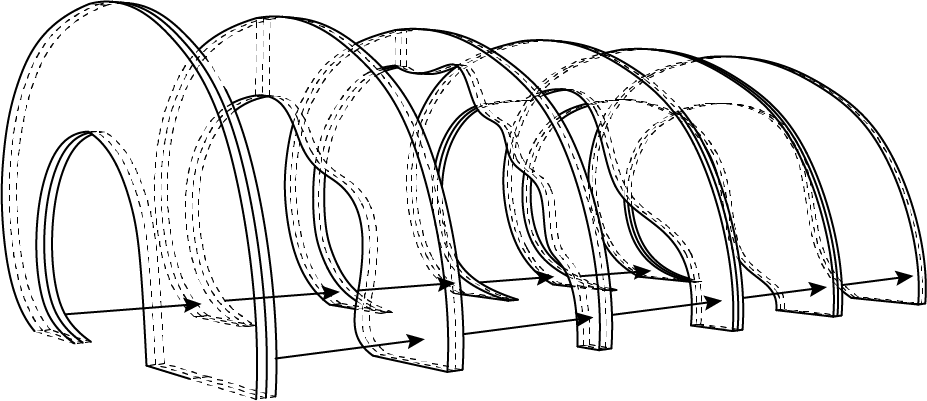
I have chosen this image as the surface I wish to develop as it appears the most interesting, from the half hidden/half transparent walls, forming like inside of a wave? To the shadow reflected in the centre from the walls of the surface, how from the shape and opacity of the layered shadow, looking like flames? bad omen?
Using the capture/sketch from above, I decided it’d be cool to create the wave like effect it appears to somewhat form referring to the coastlines that once sat on Fort Street. I like how it gives somewhat half hidden area form of the ocean and a little more transparency of the other side, giving different views in one image as I had conveyed in some of my documentation of the site.


https://en.wikipedia.org/wiki/Point_Britomart#/media/File:Auckland_Waterfront_Plan.jpg

https://digitalnz.org/records/30078958/plan-of-the-auckland-harbour-board-reclamations-1859-1926?from-story=5b4eba8b8d2a4e22d8e7d826
With undated pencil annotations of streets after reclaiming of land in Commercial Bay, such as Custom House St and Commerce St, as well as the streets Albert and Hobson. 1842


[materiality, assemble and detail]
Material – Acrylic; it give the transparent look I wish to portray and if wanting to create hidden sections could always cover over.
Assembling – Acrylic is typically glued using solvent-based glues, such as Weld-On 4. Unlike many other gluing processes, acrylic glue softens the surfaces of the acrylic and welds them together, chemically bonding the two pieces into one. When I was up in the wet lab laser cutting the layers of the surface, the lab technician recommended to use methylene chloride which is a solvent glue and best used for the attachment of acrylic for this surface model.
Detail – the key detail is the translucency but I am considering inner edges of each sections would be painted over which is seen outside as lines forming a wave like tunnel, but inside will just be coloured walls. the outside is more hidden. However, I am unsure if I would really go through with it yet, as the outer sides looking in, the thickness of the acrylic is thick enough to semi hide the inside from the outside, giving a silhouette shape which would create a pull towards it – with questions: what is there? what is it for? how do I enter?


The way I applied the Methylene Chloride solvent in-between the layers, was to hold the pieces together with masking tape on the top sides and I apply the solvent in-between the layers overtop with a syringe. Even though the glue does expand inside, the surface in-between is a bit bigger and tight so it didn’t expand as much. However, it expanded a little on the edges creating a cool bubbly kind of effected as each layer is different and the amount of solvent could vary, the look of the solvent that is transparent through the acrylic is memorising to look at as it varies throughout the whole surface.


as in the image below, it appears blurry but not totally incomprehensible to what’s on the opposing side. It is the same on both sides of the structure.
 Belinda's Blog