Peer group discussion _ 12th July 2021, Monday
Giuliano Bruno’s Public intimacy
Bruno, G. (2007). Public Intimacy: Architecture and the Visual Arts (Writing Architecture): Vol. Writing architecture series (pp. 17-21). Cambridge, Mass: The MIT Press.
Quoting/Response to Text
pg 19 ‘the filmic path is the modern version of architectural itinerary, with its own montage of cultural space’ the relationship between the film making and the architectural promenade
Pg 21 ‘…the art of memory is a form of inner writing’
‘They bear the layers of a writing that can be effaced a nd yet written over again…’
The links between the cinematic arts and the architectural aesthetics.
pg 21 ‘we require therefore places, real or imaginary, and images or simulacra which we must, of course, invent for ourselves…’ we use places as wax.
When we go to a site visit later this week, I’ll focus capturing my voyage/experience through the lane over time; a sequence of sensory experiences rather than still images or moment
pg 19 ‘film inherits the possibility of such a spectatorial voyage from architecture.’
History and the connections to the architecture whether it’s near or far. The museums are displaying stuff that show history and culture – there was a lot of research and studies before editing down the information to the essence for public display.
pg 21 ‘It bears the mark of the art of memory……..’
In every art piece there’s a story (experiences or interests) to unfold to why it was designed that way, this architectural paths holds the designer’s memory and will now hold new visitor’s memory
Reading the previous text has allowed me to think more about ‘memory’. Bruno states “memory interacts with the haptic experience of place” as it each has their individual memory of spaces depending on how they interact with the space. A normal person could use all five senses to experience a space. However, I am just lacking a tad bit in the auditory department, so is unable to experience it as a whole like others. This led me to think of a video created by Chella man who is also a deaf creator. In the video the words – “But through this loss, there is great gain … other senses heightened … Establishing a continuum of people who are different… yet connected.” were said and it really resonated with me as the amount of times I have sat in my room with my cochlear implant detached, existing in the world with with one less sense to a normal being. Seeing and feeling the world as it moves past me as silence embraces. Humming in the background as small whispers in my ear but oblivious to the surrounding noises as it all sounds the same.
Chella Man. (2021, March 15). The Beauty of Being Deaf [Video]. YouTube. https://www.youtube.com/watch?v=BRBfhQm8Lss
After reading the Giuliano Bruno’s ‘Public intimacy‘ and remembering the videography of Chella Man’s ‘The Beauty of Being Deaf’ led me into a spiral and discovered a neurological condition called synesthesia. Synesthesia is a neurological condition in which stimulation of one sensory or cognitive pathway (for example, hearing) leads to automatic, involuntary experiences in a second sensory or cognitive pathway (such as vision). Simply put, when one sense is activated, another unrelated sense is activated at the same time. This may, for instance, take the form of hearing music and simultaneously sensing the sound as swirls or patterns of colour. I wish to explore this term within my project.
It is said that auditory in a space allows the visitor to better connect with the space. Chueng-Nianby et al., (2002) reveal that research states “suddenly deafened adults reported that subjects feel a sense of disconnection from their surroundings.” As an individual who is profoundly deaf, losing my hearing at a young age I found it rather difficult to feel a sense of belonging into a space as I don’t feel like I’m experiencing it fully as I could be.
Sound is an emotion-trigger. Sound tend to bring back memories of their own experience, emotions and impressions (Yamanaka et al., 2010).
Chueng-Nainby, Priscilla & Marsden, Phil. (2002). Designing Auditory Spaces to Support Sense of Place: The Role of Expectation.
Yamanaka, Toshimasa & Mougenot, Céline & Aucouturier, Jean-Julien & Watanabe, Katsumi. (2010). Comparing the effects of visual and auditory stimuli in design creativity.
Cinematic devices research

Camera Obscura (also known as Pinhole Camera)
The Latin name meaning “dark chamber”.
Consists of smart darkened rooms with light admitted through a single tiny hole. The result was an inverted image of the outside scene casting on the opposite wall. For centuries it was a technique that was used for viewing the sun without endangering the eyes. In the 16th century it was used as an aid to drawing, as a reference to trace. As portable versions were built following even an angled mirror was used in it to reflect the image in the right view.
This leads me to think about the viewfinder which would be only experiencing the space in that small rectangle, not experiencing taking in the whole of the space.
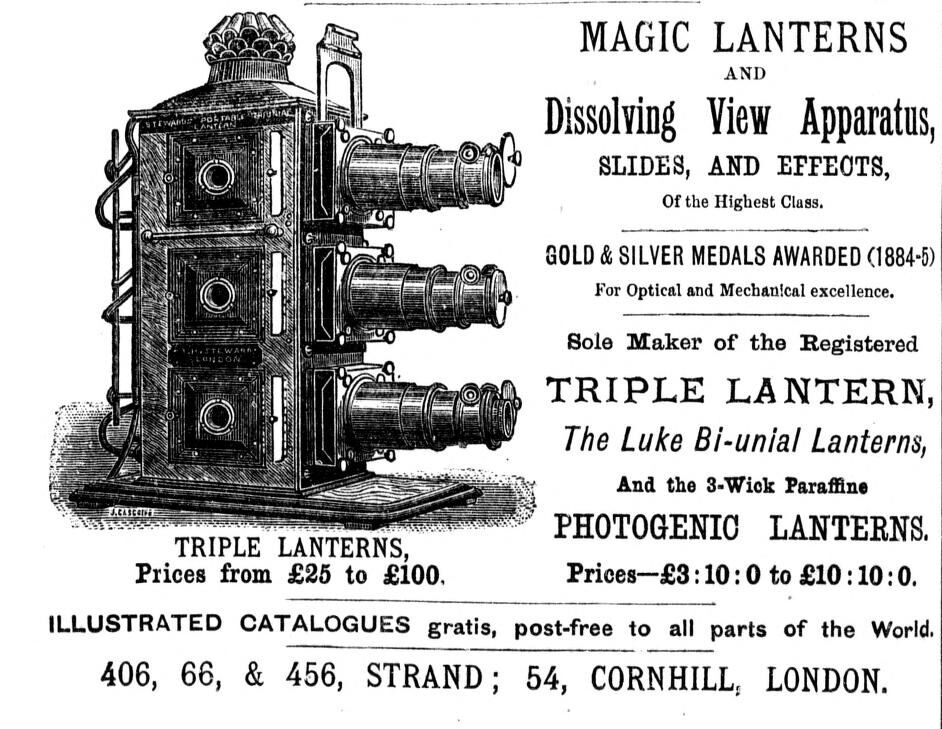
Magic Lantern
There is controversy over who actually produced the first magic lantern but it is said that a Dutch physicist Christiaan Huygens (1629-1695) was the one who constructed the first working one in around 1659. The first magic lantern was used for entertainment purposes, which led to advancements to slide presentations for scientific instructions. Improved projection technology impacted the society greatly and in the following centuries slide shows and motion pictures were fairly popular originating from creations from the magic lantern. By later 1800s, larger, more complex versions of these devices were being developed for commercial use.
The magic lantern used a concave mirror behind a light source to direct the light through a small rectangular sheet of glass—a “lantern slide” that bore the image—and onward into a lens at the front of the apparatus. The lens adjusted to focus the plane of the slide at the distance of the projection screen, which could be simply a white wall, and it therefore formed an enlarged image of the slide on the screen.

Connection with the chosen devices above of cinematology are they tend to use the a mirror as a reflection to capture onto a smaller frame.

Gong
For centuries, a gong was a symbol of success and status among Asian families – and still is to a degree. There are many uses for gongs; to communicate; make announcements; make music; accompany life’s events; meditate and heal.
I hope use the communication aspect into my design.

Claude Lorrain Glass Filters, circa 1840
Changes the mood and feeling of image.
My own cinematic device


Based off the cinematic research the ones I found quite compelling relevant to my project are ones that contain layering, reflecting and amplification. Some work from Olfur Ellasson even though are not cinematic device I found it could be the substructure of how I construct my own device. The components I hope to integrate into my device are mirrors and layering. The mirror I hoped to use was more a concave mirror, to be able to distort the image. However, I was to able to find one so normal mirroring would have to do. Though for the layering aspect, is to create a filter over the captured shot, also possibly have some hidden/blurred sections of the shot. With this project I am hoping to curate a space to experience it in a perspective with a disability.
Sketch work for cinematic device
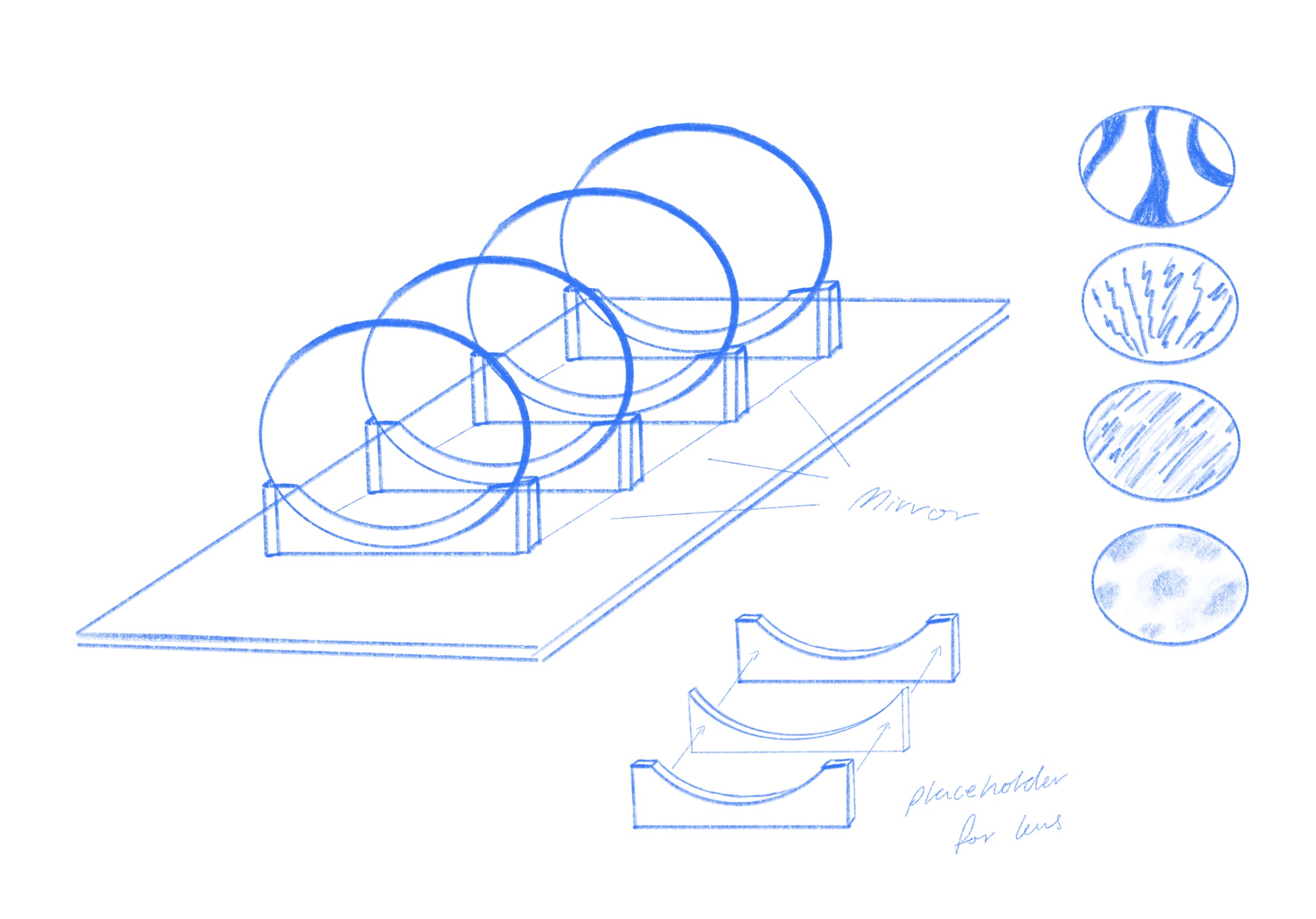


My device consists of four circles as the lenses/filter, eight curve cut rectangles as the base to hold the circles in place, four even more curved rectangles as the base to give the circles a right fit, eight small rectangles to be as the end supports though they weren’t very necessary and lastly a large rectangle to hold it all together. Later I decided to add mirrors in between each set as I thought it’d be interesting to see from different angles in one perspective. I wasn’t too sure of the circles on what technique I wished to use to give the hidden/shadowed effect I hoped to convey in the images. I had chose to use acrylic as the overall material for this device as it gives the transparency I wanted to capture the image but to construct it to hide certain aspects. Originally I hoped to use a knife to leave scratches or use a bulletpoint pen, but acrylic is thick and hard to cut through and would not work with a pen so instead I opted to paint on it.
 Belinda's Blog